
Detailed Fenerbahçe Logo History Revealed in In-Depth Archival Research
 , by Chris
- Archival Study on Fenerbahçe Crests: A comprehensive archival study by Fenerbahçe Tarihi has revealed the complete visual evolution of Fenerbahçe's club crest from 1909 to 2026, correcting previous inaccuracies.
- Evolution of the Core Emblem: The iconic circular emblem, designed by Hikmet Topuzer in 1910, incorporated the Turkish flag's colors, a central yellow-and-navy heart, and a green oak branch, largely maintaining its foundational design for over a century after an adaptation for the 1928 Turkish alphabet reform.
- Emblem Usage on Football Kits: Fenerbahçe did not regularly feature an emblem on their football match shirts until 1990, despite using various club badges across official paperwork, club premises, and non-football branches prior to that era.
A comprehensive archival study by Turkish historical platform Fenerbahçe Tarihi (@FBTarihiOrg) has shed new light on the complete visual evolution of Fenerbahçe's crest from 1909 to 2026. Dispelling numerous inaccurate chronologies found across the internet, the research documents every official variation discovered on club documents, flags, club buildings, and sports attire, charting the exact milestones of one of football's most recognizable badges.
A Century of Fenerbahçe Emblems
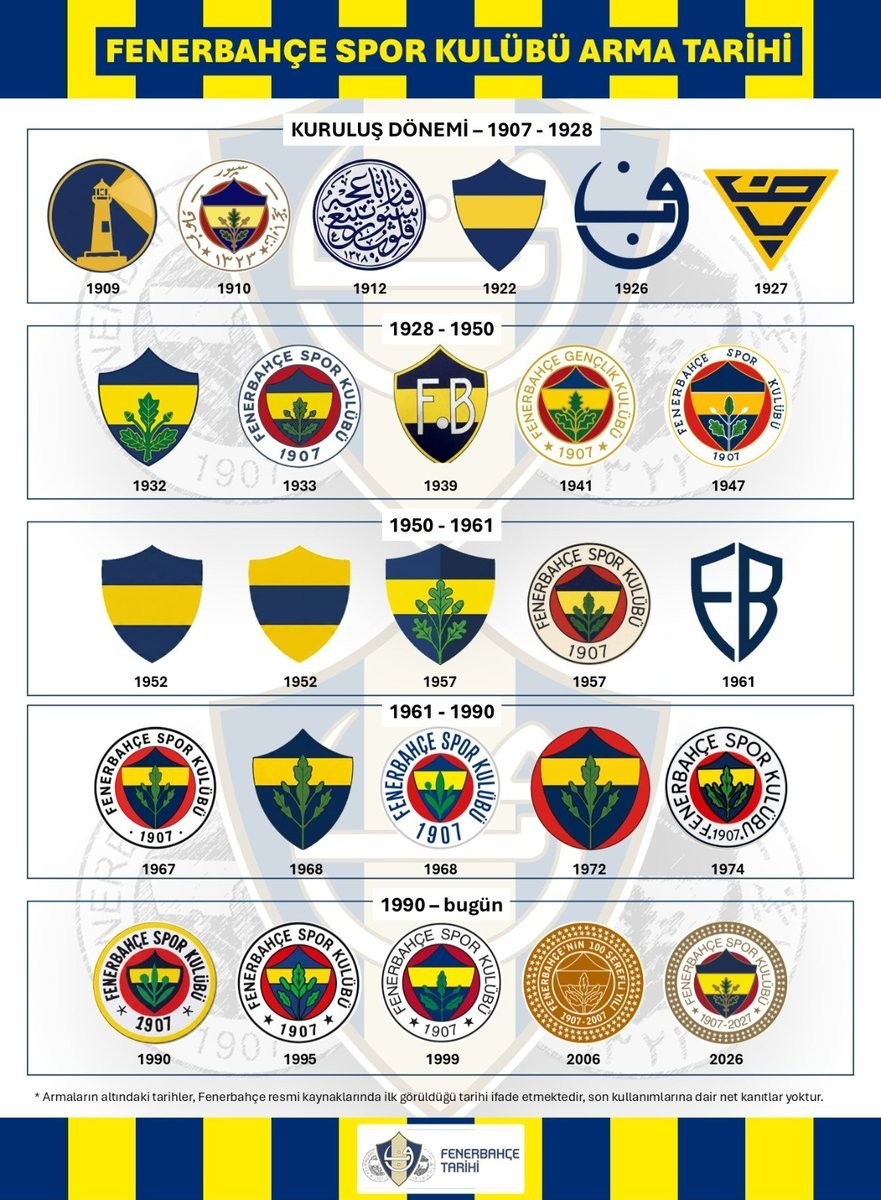
Fenerbahçe's very first emblem in 1909 drew inspiration from the famous lighthouse on the Fenerbahçe peninsula with yellow and white tones. Just a year later, in 1910, club player Hikmet Topuzer designed the core circular emblem that remains iconic today. Combining the Turkish flag's red and white with a central yellow-and-navy heart and a green oak branch representing resilience and power, the original badges were manufactured in England with the help of Tevfik Haccar. Following the 1928 Turkish alphabet reform, the original Ottoman script was adapted into Latin lettering reading "Fenerbahçe Spor Kulübü 1907", leaving the foundational design essentially untouched for over a century.
One of the key takeaways from the research is that Fenerbahçe did not regularly wear an emblem on their football match shirts until 1990. Prior to that era, club badges were used across official paperwork, club premises, and non-football branches like rowing, leading to numerous alternate monograms, simplified yellow-navy shields, and stylized iterations throughout the 1920s to the 1970s. The emblem was officially standardized into its modern corporate identity in the late 1990s, paving the way for special commemorative variations such as the 2007 centenary and the upcoming 120th anniversary marks.
Are you surprised that the club has used so many different crests? Comment below.