

Massive Sponsor Diversity in the 26-27 Champions League
- Massive Sponsor Diversity: The 26-27 UEFA Champions League features front-of-shirt sponsors from at least 15 distinct industries across its 36 competing clubs, demonstrating remarkable commercial diversity.
- Key Industries and Broad Representation: While traditional sectors such as Gambling, Finance, and Airlines hold a significant share, the competition also includes prominent brands from technology, media, telecommunications, and an eclectic mix of other sectors.
- Clubs' Varied Commercial Strategies: This extensive range of commercial partnerships illustrates the diverse strategies clubs utilize across European leagues to maximize their global visibility in the expanded 36-team Champions League phase.
A detailed infographic by Football Kit Archive reveals the remarkable diversity among front-of-shirt sponsors across all 36 clubs competing in the 26-27 UEFA Champions League. Rather than being completely dominated by one or two sectors, European football's elite stage features shirt sponsors spanning at least 15 distinct industries.
Champions League 26-27 Shirt Sponsor Breakdown
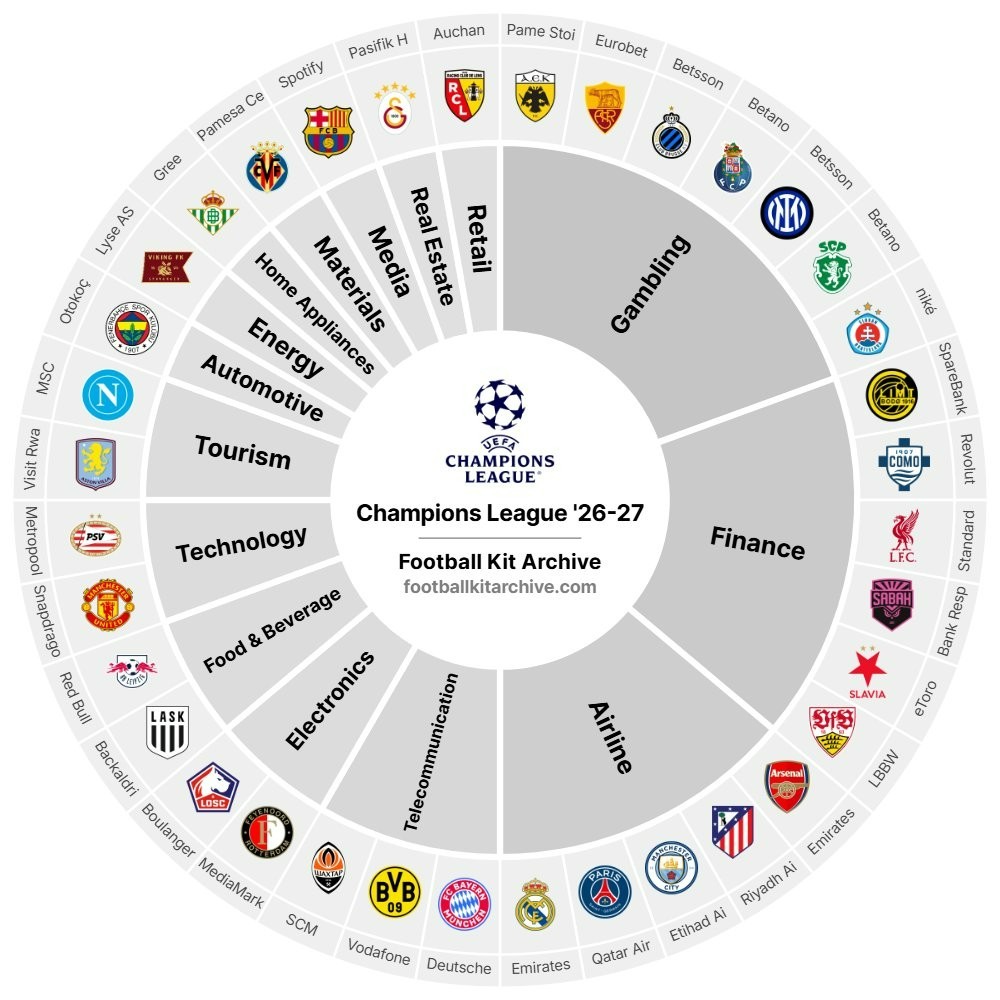
While traditional heavyweight sectors like Gambling (including Betano, Betsson, and Eurobet), Finance (Standard Chartered, Revolut, eToro, LBBW), and Airlines (Emirates, Qatar Airways, Etihad, and Riyadh Air) command a significant share of the clubs, the rest of the competition showcases huge variety.
Prominent international brands and local powerhouses occupy main shirt spaces, ranging from high-profile technology and media giants like Spotify (Barcelona) and Snapdragon (Manchester United) to telecommunications leaders like Deutsche Telekom (Bayern Munich) and Vodafone (Borussia Dortmund).
The remaining clubs display an eclectic spread of commercial partnerships, encompassing Food & Beverage (Red Bull, Backaldrin), Retail & Electronics (Auchan, MediaMarkt, Boulanger), Tourism (Visit Rwanda, MSC), Automotive, Energy, Home Appliances, and Real Estate.
This extensive spread demonstrates the varied commercial strategies across Europe's top leagues as clubs maximize their global visibility in the expanded 36-team Champions League phase.